 TinyZ's Blog


Rust 2026 经验谈 - 通道与消息传递

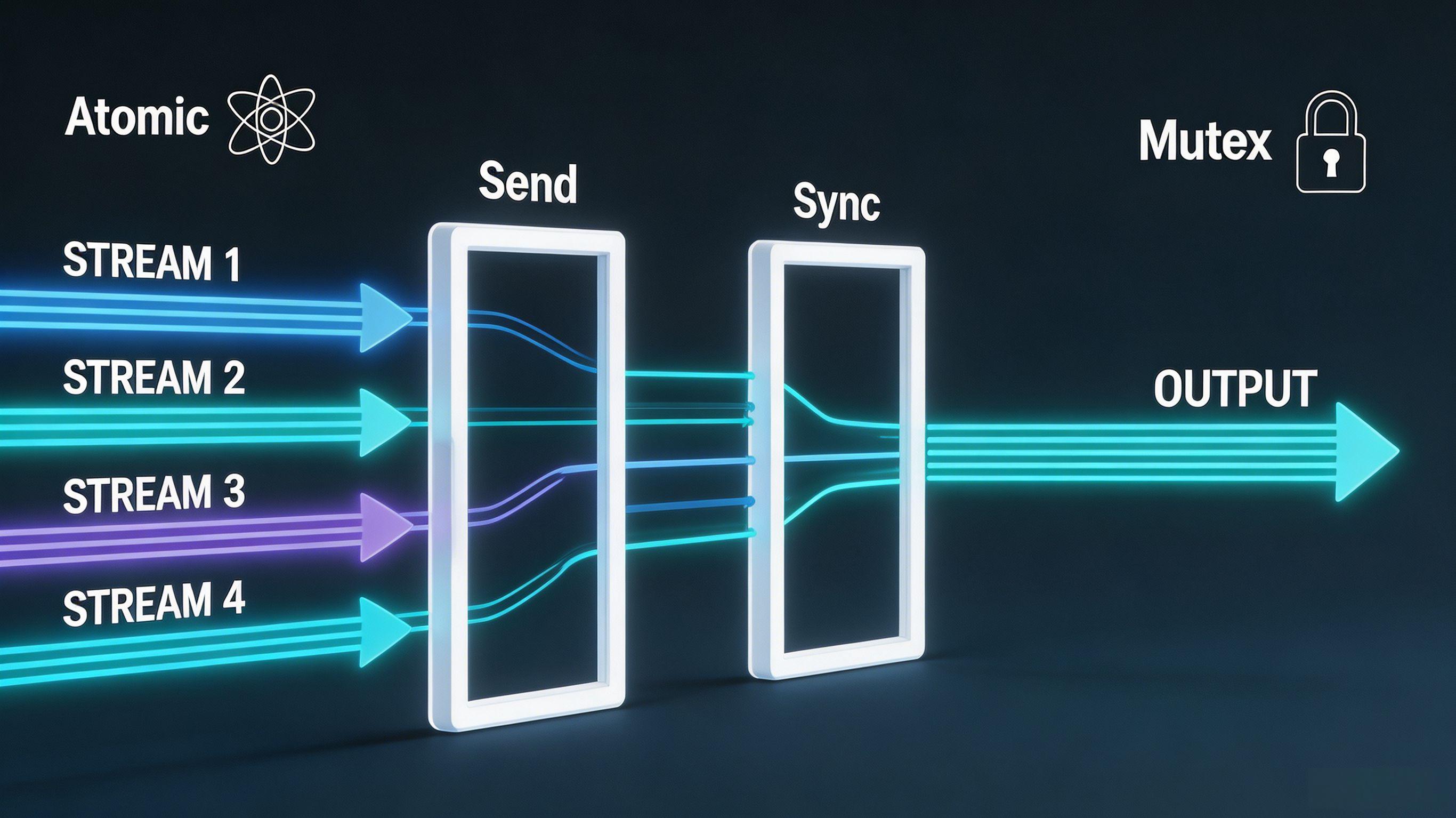
“不要通过共享内存来通信,而要通过通信来共享内存。“这句话在 Rust 中有更深的含义——channel 的所有权语义天然防止数据竞争。本文详解 Rust channel 的选型、背压、select 模式,以及与 Go channel 的关键差异。
mpsc/mpmc channel 选型
std::sync::mpsc:标准库的 MPSC
use std::sync::mpsc;use std::thread;
fn std_mpsc_example() { let (tx, rx) = mpsc::channel();
thread::spawn(move || { tx.send("hello".to_owned()).unwrap(); tx.send("world".to_owned()).unwrap(); });
// rx 在主线程 while let Ok(msg) = rx.try_recv() { println!("收到: {msg}"); }}std::sync::mpsc 的特点:
| 特性 | 支持情况 |
|---|---|
| 多生产者 | 支持(tx.clone()) |
| 单消费者 | 是(Receiver 不 Clone) |
| 有界 channel | sync_channel(capacity) |
| 无界 channel | channel() |
| select | 已废弃(select! 宏在 1.0 前) |
| 性能 | 一般(内部用 Mutex + Condvar) |
踩坑:std::sync::mpsc 的 Receiver 不是 Sync,意味着你不能在多线程中同时从同一个 channel 读取。如果你需要多消费者,必须换方案。
crossbeam-channel:高性能 MPMC
use crossbeam_channel as channel;use std::thread;
fn crossbeam_example() { let (tx, rx) = channel::bounded(100);
// 多生产者 let mut producers = vec![]; for i in 0..4 { let tx = tx.clone(); producers.push(thread::spawn(move || { for j in 0..50 { tx.send((i, j)).unwrap(); } })); }
// 多消费者 let mut consumers = vec![]; for _ in 0..2 { let rx = rx.clone(); consumers.push(thread::spawn(move || { while let Ok((i, j)) = rx.recv() { println!("消费者收到: producer={i}, item={j}"); } })); }
// 关闭生产者 drop(tx); for p in producers { p.join().unwrap(); } // 消费者会在 channel 关闭后退出 for c in consumers { c.join().unwrap(); }}crossbeam-channel 的优势:
| 特性 | std::sync::mpsc | crossbeam-channel |
|---|---|---|
| MPMC | 否 | 是 |
| select | 否 | 是(select! 宏) |
| 性能 | ~200ns/op | ~50ns/op |
| 有界/无界 | 都支持 | 都支持 |
Receiver: Clone | 否 | 是 |
| 零分配(bounded) | 否 | 是(环形缓冲区) |
Send 超时 | 否 | 是(send_timeout) |
flume:异步友好的 MPMC
use flume;use std::thread;
fn flume_example() { let (tx, rx) = flume::bounded(50);
// flume 的 rx 可以同时用于同步和异步 // 异步接收 let rx_async = rx.clone(); let async_task = tokio::spawn(async move { while let Ok(msg) = rx_async.recv_async().await { println!("异步收到: {msg}"); } });
// 同步发送 thread::spawn(move || { for i in 0..100 { if tx.send(i).is_err() { break; } } });}flume 的特点:
| 特性 | crossbeam-channel | flume |
|---|---|---|
| 异步支持 | 否 | 是(recv_async/send_async) |
| MPMC | 是 | 是 |
| select | 是 | 否(用 tokio::select! 代替) |
| 性能 | 最高 | 略低(~70ns/op) |
| 无 std 依赖 | 否 | 可选(no_std 支持) |
选型决策树
需要 channel?├── 只需 MPSC + 不需要 select?│ └── std::sync::mpsc(零依赖)├── 需要 MPMC 或 select?│ ├── 需要异步支持?│ │ └── flume│ └── 纯同步高性能?│ └── crossbeam-channel└── 在 tokio 运行时中? └── tokio::sync::mpsc(异步原生)channel 背压策略
有界 vs 无界:核心选择
use crossbeam_channel as channel;
// 无界:生产者永远不会阻塞let (tx, rx) = channel::unbounded();// 风险:如果生产者速度 >> 消费者速度,内存暴涨
// 有界:生产者在满时阻塞let (tx, rx) = channel::bounded(1000);// 优势:天然背压,生产者被限速踩坑故事:我曾在一个日志系统中用无界 channel,消费者写磁盘慢时,channel 中积压了几百万条日志,最终 OOM。改用 bounded(10000) 后,生产者在 channel 满时阻塞,日志丢不了,内存也稳定了。
有界 channel 的三种策略
use crossbeam_channel::{bounded, SendError, TrySendError};use std::time::Duration;
let (tx, rx) = bounded(100);
// 策略 1:阻塞等待(默认行为)// 适用于:不能丢消息,可以容忍生产者慢match tx.send(42) { Ok(()) => {} Err(SendError(_)) => println!("channel 已关闭"),}
// 策略 2:非阻塞尝试 + 丢弃// 适用于:宁可丢消息也不能阻塞(如监控指标)match tx.try_send(42) { Ok(()) => {} Err(TrySendError::Full(_)) => { // channel 满了,丢弃这条消息 // 或者记到本地缓冲区 } Err(TrySendError::Disconnected(_)) => {}}
// 策略 3:超时等待// 适用于:等一会儿,实在不行就放弃match tx.send_timeout(42, Duration::from_millis(100)) { Ok(()) => {} Err(crossbeam_channel::SendTimeoutError::Disconnected(_)) => println!("channel 已关闭"), Err(crossbeam_channel::SendTimeoutError::Timeout(_)) => println!("发送超时"),}动态背压:根据消费速度调整
use crossbeam_channel as channel;use std::sync::atomic::{AtomicUsize, Ordering};use std::time::Duration;
struct AdaptiveProducer { tx: channel::Sender<i32>, backpressure_count: AtomicUsize,}
impl AdaptiveProducer { fn send(&self, item: i32) -> bool { match self.tx.try_send(item) { Ok(()) => { self.backpressure_count.store(0, Ordering::Relaxed); true } Err(channel::TrySendError::Full(_)) => { let count = self.backpressure_count.fetch_add(1, Ordering::Relaxed); // 指数退避 let backoff_ms = 1u64 << count.min(10); std::thread::sleep(Duration::from_millis(backoff_ms)); // 重试一次 self.tx.try_send(item).is_ok() } Err(channel::TrySendError::Disconnected(_)) => false, } }}有界 channel 容量选择指南
| 场景 | 推荐容量 | 原因 |
|---|---|---|
| 任务分发 | CPU 核数 × 2 | 平衡延迟和吞吐 |
| 日志收集 | 1000 ~ 10000 | 批量写入磁盘 |
| 事件流 | 根据峰值 × 时间窗口 | 吸秒级突发 |
| 控制信号 | 1 ~ 10 | 低延迟优先 |
经验:channel 容量不是越大越好。容量越大,缓存行竞争越严重,吞吐量反而下降。用 benchmark 调参。
select 模式
crossbeam select 基本用法
use crossbeam_channel as channel;
fn select_example() { let (tx1, rx1) = channel::bounded(1); let (tx2, rx2) = channel::bounded(1);
thread::spawn(move || { tx1.send("from channel 1").unwrap(); }); thread::spawn(move || { tx2.send("from channel 2").unwrap(); });
// select:等待多个 channel,哪个先就绪就处理哪个 channel::select! { recv(rx1) -> msg => println!("rx1: {:?}", msg), recv(rx2) -> msg => println!("rx2: {:?}", msg), }}多轮 select + 超时
use crossbeam_channel as channel;use std::time::Duration;
fn event_loop(rx1: channel::Receiver<i32>, rx2: channel::Receiver<String>) { let timeout = channel::after(Duration::from_secs(5)); let tick = channel::tick(Duration::from_millis(100));
loop { channel::select! { recv(rx1) -> msg => { match msg { Ok(val) => println!("收到数字: {val}"), Err(_) => break, // channel 关闭 } } recv(rx2) -> msg => { if let Ok(val) = msg { println!("收到字符串: {val}"); } } recv(tick) -> _ => { // 定时任务:每 100ms 执行一次 // 如:心跳、指标采集 } recv(timeout) -> _ => { println!("5 秒超时,退出"); break; } } }}优先级 select
crossbeam 的 select! 是公平的(随机选择就绪的 channel)。如果需要优先级,手动实现:
use crossbeam_channel as channel;
fn priority_select(high: channel::Receiver<i32>, low: channel::Receiver<i32>) { loop { // 先检查高优先级 if let Ok(val) = high.try_recv() { println!("高优先级: {val}"); continue; } // 高优先级无消息时,select 等待 channel::select! { recv(high) -> msg => { if let Ok(val) = msg { println!("高优先级: {val}"); } } recv(low) -> msg => { if let Ok(val) = msg { println!("低优先级: {val}"); } } } }}与 Go channel 的对比
所有权语义:最本质的差异
// Rust:值被 move 到 channel 中let (tx, rx) = std::sync::mpsc::channel();let data = vec![1, 2, 3];tx.send(data).unwrap();// data 在这里已经不可用了!所有权转移到了 channel// println!("{:?}", data); // 编译错误!// Go:值被复制到 channel 中data := []int{1, 2, 3}ch <- data// data 仍然可用fmt.Println(data) // 正常工作这是最根本的差异:Rust channel 传递所有权,Go channel 传递值的副本。
这意味着:
| 维度 | Rust channel | Go channel |
|---|---|---|
| 语义 | Move(所有权转移) | Copy(值复制) |
| 零拷贝 | 天然支持(move 无开销) | 需要传指针 |
| 共享引用 | 编译期禁止(除非 Arc) | 运行时允许(传指针后共享) |
| 数据竞争 | 编译期消除 | 运行时检测(race detector) |
Go 传指针的问题
// Go:传指针到 channel —— 危险!data := &MyStruct{...}ch <- data // 传递了指针// 现在 sender 和 receiver 都能访问同一数据// 如果 sender 继续修改 data —— 数据竞争!Go 社区的最佳实践是”传值不传指针”或”传指针后不再使用”——但这只是约定,编译器不强制。
Rust 的 channel 天然解决了这个问题:send(data) 之后 data 被 move,发送者无法再访问。
buffered channel 行为对比
// Rust (crossbeam):bounded channel 满时,send 阻塞let (tx, rx) = crossbeam_channel::bounded(1);tx.send(1).unwrap(); // 成功tx.send(2).unwrap(); // 阻塞,直到有接收者// Go:buffered channel 满时,send 也阻塞ch := make(chan int, 1)ch <- 1 // 成功ch <- 2 // 阻塞行为一致,但 Rust 的 bounded channel 在 crossbeam 实现中是无锁的(SPSC 时),性能优于 Go 的 channel(Go channel 内部有锁)。
channel 关闭语义
// Rust (std::sync::mpsc):drop 所有 Sender 后,recv 返回 Errlet (tx, rx) = std::sync::mpsc::channel();drop(tx);assert!(rx.recv().is_err()); // channel 关闭// Go:close(ch) 后,recv 返回零值ch := make(chan int, 1)close(ch)val, ok := <-ch // val = 0, ok = falseGo 的 close 是显式的,Rust 的”关闭”是隐式的(drop Sender)。Go 的方式更灵活但也更危险——close 一个已经 close 的 channel 会 panic,向一个 closed channel 发送也会 panic。Rust 不会。
MPSC 在生产者-消费者模式中的实战
模式一:工作窃取任务池
use crossbeam_channel as channel;use std::thread;
struct WorkerPool { senders: Vec<channel::Sender<Task>>, steal_rx: channel::Receiver<Task>,}
struct Task { id: usize, payload: Vec<u8>,}
impl WorkerPool { fn new(num_workers: usize) -> Self { let (steal_tx, steal_rx) = channel::bounded(100);
let mut senders = vec![]; for _ in 0..num_workers { let (tx, rx) = channel::bounded(50); let steal_tx = steal_tx.clone(); thread::spawn(move || { loop { // 优先从自己的队列取任务 match rx.try_recv() { Ok(task) => Self::process(task), Err(_) => { // 队列空,尝试窃取或等待 match channel::select! { recv(rx) -> task => { if let Ok(t) = task { Self::process(t); } else { break; } } recv(steal_rx) -> task => { if let Ok(t) = task { Self::process(t); } } } } } } }); senders.push(tx); }
WorkerPool { senders, steal_rx } }
fn submit(&self, task: Task) { // 轮询分发到 worker static COUNTER: std::sync::atomic::AtomicUsize = std::sync::atomic::AtomicUsize::new(0); let idx = COUNTER.fetch_add(1, std::sync::atomic::Ordering::Relaxed) % self.senders.len(); if self.senders[idx].try_send(task).is_err() { // worker 满了,放入窃取队列 let _ = self.senders[0].send(task); } }
fn process(task: Task) { // 实际处理逻辑 println!("处理任务 {}", task.id); }}模式二:流水线(Pipeline)
use crossbeam_channel as channel;use std::thread;
fn pipeline_example() { // Stage 1: 生成数据 let (input_tx, input_rx) = channel::bounded(100);
// Stage 2: 解析 let (parsed_tx, parsed_rx) = channel::bounded(100); let parse_rx = input_rx.clone(); thread::spawn(move || { while let Ok(raw) = parse_rx.recv() { let parsed: i32 = raw.parse().unwrap_or(0); if parsed_tx.send(parsed).is_err() { break; } } });
// Stage 3: 过滤 let (filtered_tx, filtered_rx) = channel::bounded(100); thread::spawn(move || { while let Ok(val) = parsed_rx.recv() { if val > 0 { if filtered_tx.send(val).is_err() { break; } } } });
// Stage 4: 聚合 thread::spawn(move || { let mut sum = 0i64; let mut count = 0usize; while let Ok(val) = filtered_rx.recv() { sum += val as i64; count += 1; } println!("总和: {sum}, 数量: {count}"); });
// 喂数据 for i in 0..1000 { input_tx.send(i.to_string()).unwrap(); } drop(input_tx);}流水线模式的优势:每个 stage 独立运行,可以分配到不同线程,backpressure 自然传播。
模式三:扇出-扇入(Fan-out/Fan-in)
use crossbeam_channel as channel;use std::thread;
fn fan_out_fan_in() { let (input_tx, input_rx) = channel::bounded(100); let (output_tx, output_rx) = channel::bounded(100);
// 扇出:多个 worker 从同一 input 读取(MPMC) let num_workers = 4; for worker_id in 0..num_workers { let rx = input_rx.clone(); let tx = output_tx.clone(); thread::spawn(move || { while let Ok(item) = rx.recv() { let result = item * 2; // 处理 if tx.send((worker_id, result)).is_err() { break; } } }); } drop(input_rx); // 关闭 worker 的接收端 drop(output_tx); // 关闭 worker 的发送端
// 扇入:一个收集者从 output 读取 thread::spawn(move || { while let Ok((worker_id, result)) = output_rx.recv() { println!("worker {worker_id} 产出: {result}"); } });
// 喂数据 for i in 1..=100 { input_tx.send(i).unwrap(); } drop(input_tx);}实战经验总结
1. 永远用 bounded channel,除非你确信不会积压
无界 channel 是 OOM 的温床。bounded channel 提供天然背压,是系统稳定性的保障。
2. channel 容量调优靠 benchmark,不靠猜
从 CPU 核数 × 2 开始,用真实负载 benchmark 调优。容量太小导致吞吐下降,太大增加延迟和内存。
3. Rust channel 的所有权是特性,不是限制
Go 程序员初学 Rust 时常觉得 channel “不够灵活”——不能共享引用。但这正是 Rust 消除数据竞争的机制。用 Arc 包装需要共享的数据,而非传引用。
4. crossbeam 的 select 是同步世界的利器
如果你在做事件循环、多路复用、超时控制,crossbeam::select! 比手写 poll 循环简洁且正确得多。
5. 异步世界用 tokio::sync::mpsc,同步世界用 crossbeam
不要在 tokio 运行时中用 std::sync::mpsc——它的阻塞会浪费整个 worker thread。用 tokio::sync::mpsc 让 await point 正确让出。
支持与分享
如果这篇文章对你有帮助,欢迎分享给更多人或赞助支持!
评论区
音乐
暂未播放